


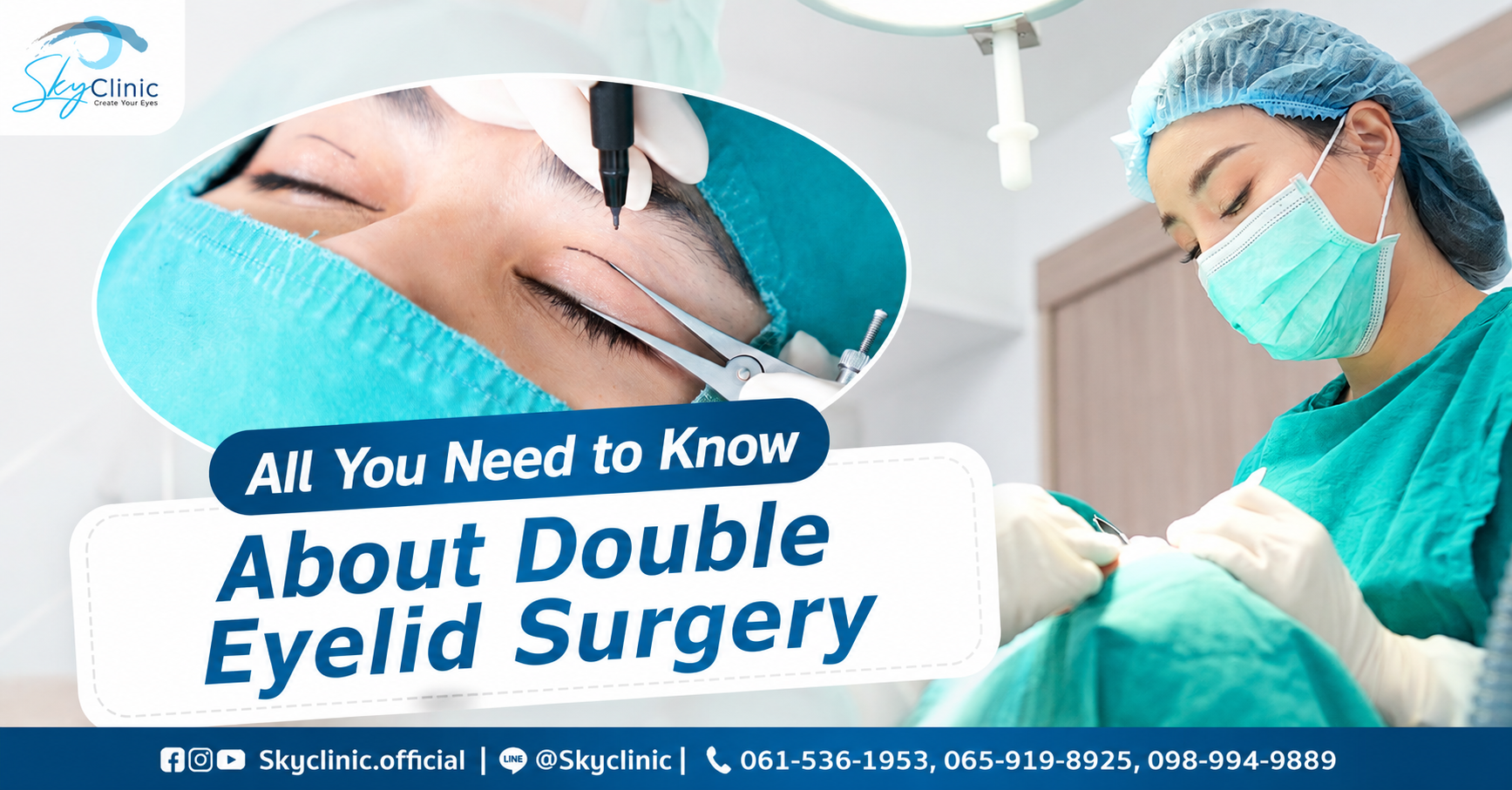
Answer all questions about double eyelid surgery.




Frequently Asked Questions About Double Eyelid Surgery
1. What double eyelid surgery techniques does Sky Clinic offer?
There are two main techniques:
- Small-incision long crease technique
- Full-incision technique
The most suitable method depends on each patient’s individual eye condition and concerns.
2. How do patients know which technique is right for them?
The doctor will evaluate each patient’s eye anatomy and concerns individually. Some patients are suitable for the small-incision technique, while others may require a full-incision approach because every eye structure is different.
3. What is the small-incision long crease technique?
This technique involves creating a very small incision, approximately 0.5 cm long, along the eyelid crease. The eyelid fold is then carefully stitched internally.
Because the scar is hidden within the natural eyelid fold, it is usually difficult to see when opening or closing the eyes.
4. How long is the recovery time for the small-incision technique?
Recovery is generally very quick. Most patients can return to normal daily activities almost immediately because the incision is small and swelling is minimal.
5. Can fat be removed with the small-incision technique?
Yes. Excess eyelid fat can also be removed using the small-incision technique, similar to the full-incision method.
6. What is the full-incision technique?
The full-incision technique allows the surgeon to remove excess eyelid skin in addition to creating the eyelid crease, making it suitable for patients with sagging eyelids or excess skin.
7. Is double eyelid surgery permanent?
The created eyelid crease itself is generally permanent. However, as aging continues, the eyelid skin may gradually sag and partially cover the crease, making it appear smaller over time.
8. How long does the procedure take?
The surgery usually takes between 30 minutes to 1.5 hours, depending on the complexity of the case and the surgical technique used.
9. Are stitches removed after surgery? Can makeup be worn immediately?
Yes, stitches are typically removed because the incision usually dries within 5–7 days.
Patients may wear makeup on other parts of the face immediately, but eye makeup around the eyelids should be avoided until healing is complete.
10. How should patients care for the eyelids after surgery?
- During the first 24 hours, gentle pressure and cooling help reduce swelling and remove residual blood or anesthetic fluid.
- During the first 72 hours, cold compresses are recommended to reduce swelling and speed recovery.
- After 72 hours, warm compresses help dissolve bruising and improve healing.
11. What are possible side effects of double eyelid surgery?
Common temporary side effects may include:
- Swelling and bruising
- Small bumps along the suture line
- Difficulty fully closing the eyes during early healing
- Mild redness in the white part of the eye
These symptoms generally improve naturally within weeks to months.
12. How should patients prepare before surgery?
It is recommended to stop taking vitamins and dietary supplements approximately one month before surgery, especially supplements that may increase bleeding risk.
13. Can double eyelid surgery remove crow’s feet?
No. Double eyelid surgery does not treat crow’s feet because it does not affect the outer eye area. Botox may be recommended for reducing crow’s feet.
14. When can contact lenses be worn again after surgery?
Most patients can resume wearing contact lenses about one week after surgery.
15. Why can the lower eyelids bruise after upper eyelid surgery?
Bruising can spread downward because the tissues around the eyes are connected. Gravity may cause blood to move toward the lower eyelids, especially while standing or walking. This is considered normal.
16. Can upper eyelid surgery and lower under-eye bag surgery be performed together?
Yes. Both procedures can usually be performed during the same surgical session.
17. What is the minimum age for double eyelid surgery?
For medical conditions such as ptosis correction, surgery may be performed even in childhood if vision is affected.
For cosmetic purposes, surgery is generally recommended after age 18, while legal consent typically requires patients to be at least 20 years old.
18. How long does it take for the eyelids to fully settle?
Most eyelids settle into their final shape within 3–6 months, although healing time varies between individuals.
19. How long should patients wait before revision surgery?
For revision cases, it is generally recommended to wait at least 6 months for the eyelids to fully heal and stabilize before additional correction.
20. How long does it take for scars to fade?
In most cases, scars gradually fade over approximately 6 months.
Source : Dr.Sky Burapadecha