


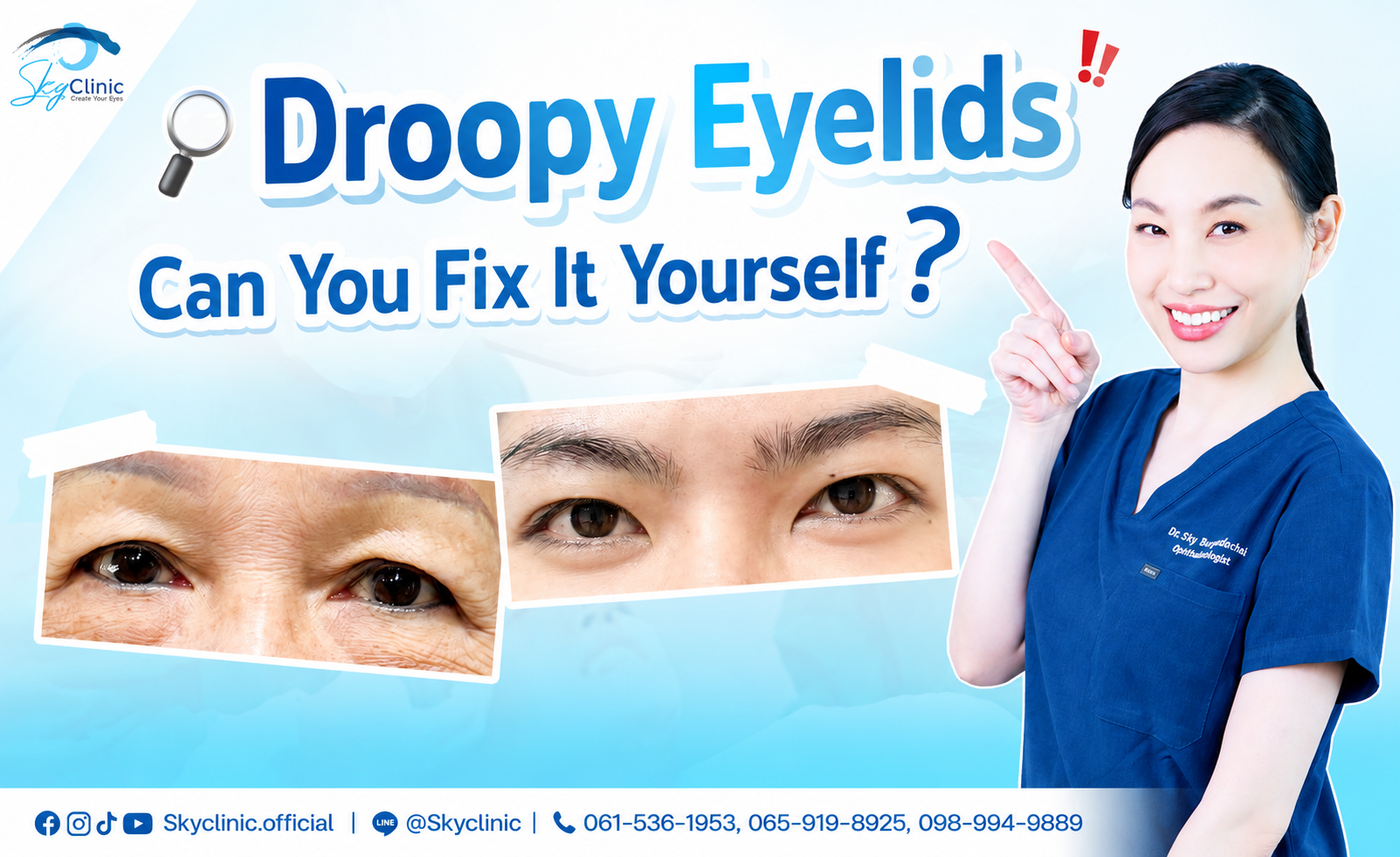
Can drooping eyelids heal on their own?




I'm sure no one wants to have problems around their eyes, right? Especially problems that affect daily life. One of the most common eye problems is drooping eyelids. This is a problem that causes many people to worry and wonder: Can drooping eyelids go away on their own? What causes drooping eyelids? Can drooping eyelids be corrected? What about drooping eyelids on only one side? Today, Sky Clinic will help you find the answers to your concerns and questions about drooping eyelids.
What are drooping eyelids?
Drooping eyelids refer to a condition where the eyelid droops or sags excessively, covering the upper part of the eyeball more than normal. This can affect vision and daily life, depending on the severity of the eyelid drooping and obstruction.
Symptoms indicating drooping eyelids.
The eyelid droops or falls down, obstructing the view of the eye.
The two eyes appear uneven due to one eyelid drooping more than normal.
Eye strain or pain can result from repeatedly raising your eyebrows or tilting your head back to see more clearly.
Causes of drooping eyelids.

Increasing age Aging is the most common cause, as we age, the skin and muscles around the eyes weaken, leading to sagging eyelids that can droop and obstruct the pupil. Additionally, the accumulation of fat in the eyelids is another factor that exacerbates eyelid drooping and sagging.
It's caused by weak eye muscles.
Drooping eyelids, caused by weakened eye muscles, can be congenital (genetic) or develop later in life as the muscles responsible for opening the eye gradually deteriorate. It can affect both eyes or just one eye.Lifestyle habits
Lifestyle habits are another cause that many people may not consider and therefore don't pay attention to. For example, frequently rubbing the eyes, wiping off eye makeup too hard, and using double eyelid stickers. These lifestyle habits can all contribute to drooping eyelids or tired-looking eyes prematurely.Other diseases or conditions
Drooping eyelids can occur due to nerve dysfunction, such as from injury or accident, diabetes, facial paralysis, or a brain tumor pressing on the nerve that controls eyelid lifting.
Can drooping eyelids heal on their own?
Drooping eyelids do not resolve on their own, as the primary cause is usually a problem with the muscles or nerves that control eyelid lifting. Treatment by a doctor is necessary. Furthermore, drooping eyelids can occur at any age and have various causes, each requiring a different treatment. Therefore, proper diagnosis and treatment should be performed by a specialist with knowledge and expertise in the structures around the eye – an ophthalmologist – to ensure correct and safe treatment of drooping eyelids.
Methods for treating drooping eyelids.
There are two ways to treat drooping eyelids:
surgery - This is the most commonly used method for treating ptosis (drooping eyelids) caused by excess skin or fat around the eyes, as well as hereditary conditions such as ptosis (weak eye muscles).
The surgical methods used include: :
Upper lid blepharoplasty (surgical double eyelid surgery with long incision) : This is a double eyelid surgery combined with removal of excess eyelid skin and fat. It is suitable for those with drooping eyelids and excess fat in the eyelid area.
Ptosis Correction Surgery : This is a surgical procedure to correct problematic muscles that cause drooping eyelids or limited eyelid opening. It is often performed in conjunction with double eyelid surgery and is suitable for those with drooping eyelids and sleepy eyes.
Sub Brow Lift (Surgical procedure to hide the scar under the eyebrow) : This is a surgical procedure to remove excess eyelid skin and fat under the eyebrows. This lifts sagging eyelid skin, making existing double eyelids more visible. It can also be combined with double eyelid surgery for those with indistinct double eyelids.
Facial and eye lifting procedure. - This method is suitable for those with mild to moderate eyelid sagging, who do not want surgery, and who desire a natural eye lift without a long recovery period.
Facial and eye lifting procedures include: :HIFU (High-Intensity Focused Ultrasound) : High-intensity ultrasound waves are used to stimulate collagen production in the deep layers of the skin, helping to lift and tighten the skin around the eyes and reduce sagging.
Ulthera SPT (See, Plan, Treat) : Using ultrasound technology, the treatment layers can be clearly visualized, allowing doctors to plan and treat with precision, effectively lifting eyelids and reducing wrinkles.
Ultra Lift : This technology uses radio waves to lift and tighten the skin and stimulate collagen production, resulting in firmer skin around the eyes and reducing eyelid sagging.
All three procedures mentioned above are non-surgical methods that can help lift and tighten the eyelids, providing natural-looking results. However, it is advisable to consult with a specialist to choose the method most suitable for each individual's eyelid ptosis.
Examples of patients with drooping eyelids who underwent surgical treatment at Sky Clinic by expert ophthalmologists.

Sweet Eyes technique: Long eyeliner application and upper lid blepharoplasty.

Sweet Eyes technique: Long incision upper lid blepharoplasty
combined with correction of weak eye muscles (Ptosis Correction).

Technique for concealing scars under the eyebrow (Sub Brow Lift)
As mentioned, drooping eyelids can significantly impact daily life and self-esteem. However, various solutions are available today, depending on the cause and severity of the problem. These include surgery and facelift procedures. The choice of method depends on the patient's needs and desires. Besides correcting drooping eyelids, these procedures can enhance the beauty of the eyes, boost confidence, and allow patients to live life to the fullest without worry. For more information on drooping eyelids, please consult with a specialist ophthalmologist at Sky Clinic. The doctor will assess your problem and recommend the most suitable solution.
Source : Sky Clinic