


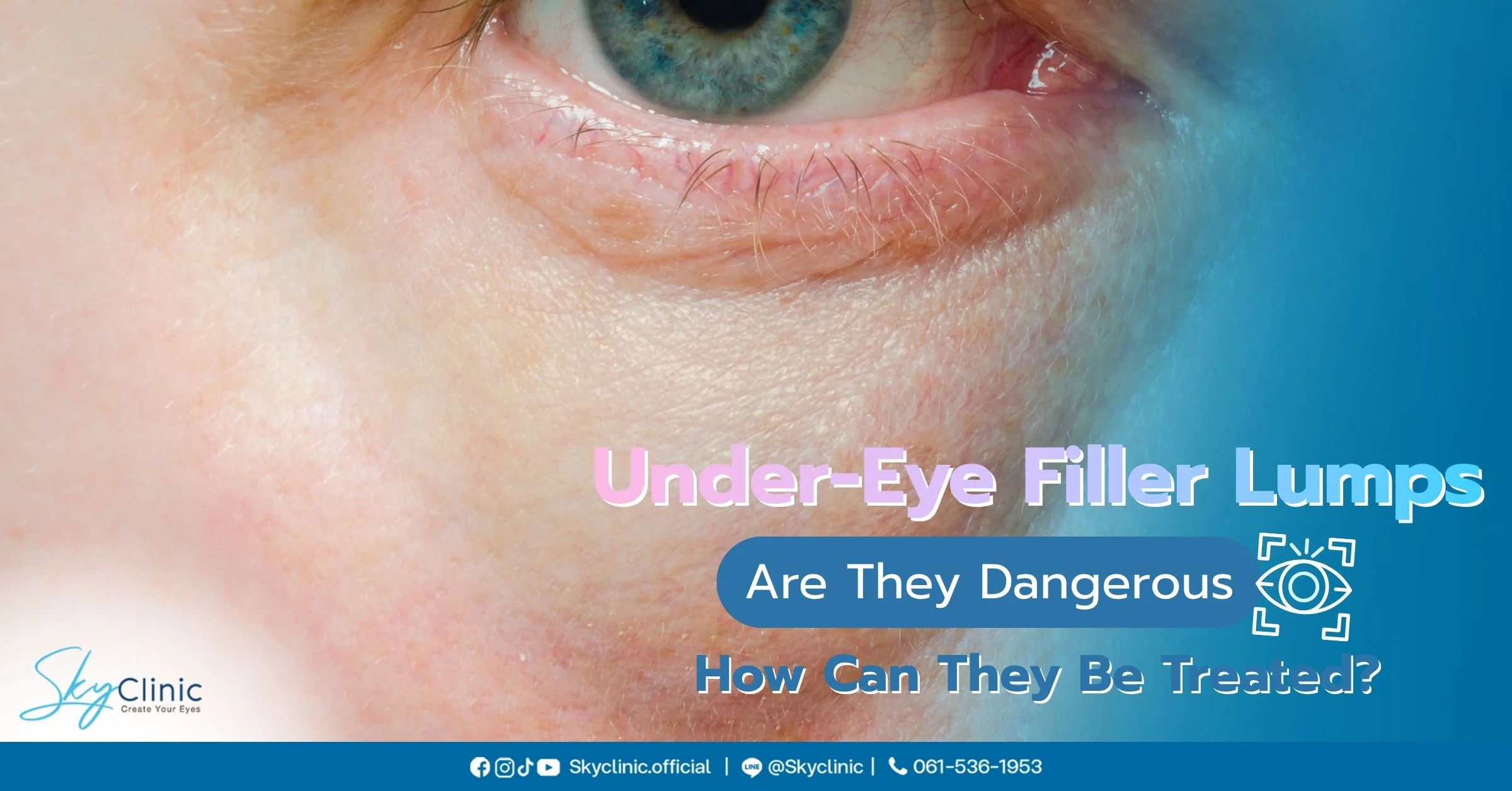
What Causes Lumpy Under-Eye Filler, and How Can It Be Treated?




Dark under-eyes and deep tear troughs are concerns for many people. As a result, under-eye filler injections have become a popular option for instantly creating a brighter and more refreshed appearance. However, one common concern that may follow is the development of lumpy under-eye filler, which can occur for several reasons. Understanding the causes and characteristics of these lumps is important in choosing the most appropriate and safe treatment approach for long-term eye health. Learn more about the causes and proper correction methods in the information below.
What does Lumpy Under-Eye Filler Look Like?
Lumpy under-eye filler can often be identified visually or by touch. Symptoms may vary depending on the type of filler used and each individual’s reaction to the product. In general, the condition can be divided into two main types, which help with assessing the severity in the initial stage, as follows:
Non-Inflammatory Under-Eye Lumps
This type usually appears as visible unevenness or raised edges under the eyes, especially when moving the facial muscles or smiling. The filler may bulge outward like a small worm-shaped lump or resemble a fluid-filled pouch beneath the skin. When touched, the area may feel soft and elastic to the touch without any pain. This condition is often caused by improper injection techniques or the use of filler products with excessively high firmness for the delicate under-eye area, preventing the filler from blending naturally with the surrounding tissue
Under-Eye Lumps Accompanied by Swelling, Pain, or Inflammation
If the lump appears with redness, swelling, warmth, or tenderness when touched, it may be a warning sign of inflammation or infection. This is often seen in cases where non-standard filler materials are used or when contamination occurs during the injection process. These symptoms may appear immediately after the procedure or even years later. If any of these abnormalities are noticed, prompt evaluation and treatment by an experienced ophthalmologist are strongly recommended.
What Causes Lumpy Under-Eye Filler?
Several factors can cause under-eye filler to become lumpy, ranging from the quality of the product used to each individual’s skin anatomy. Understanding these causes can help with prevention and selecting the most appropriate corrective treatment. The most common causes include the following:
Use of counterfeit filler or non-standard dermal filler substance
Receiving fillers such as liquid silicone or other non-absorbable substances is considered one of the most serious causes of lumpy under-eye filler. The body recognizes these substances as foreign materials and attempts to isolate them by forming fibrous tissue, which can eventually lead to hard lumps, migration, or deformity over time. Treatment is significantly more difficult compared with genuine hyaluronic acid fillers because these substances cannot be dissolved with injectable enzymes and may require surgical removal instead.
Choosing a filler type that is not suitable for the under-eye area
The under-eye skin is one of the thinnest and most delicate areas of the face. If a filler with larger molecules or excessively high firmness (high G-prime) is used—similar to fillers designed for structural support in areas such as the cheekbones—it may not spread or integrate smoothly with the surrounding tissue. As a result, the filler can appear as visible lumps or uneven contours, looking unnatural, especially when the eye muscles move while smiling or speaking.
Injection into the wrong layer of skin or incorrect placement of filler
Proper filler placement technique is extremely important. If the filler is injected too superficially or into the orbicularis oculi muscle layer, it may become visibly lumpy or cause the Tyndall effect, where the treated area appears bluish or dark due to light scattering through the skin. Correct under-eye filler placement should be in the deep fat layer or near the bone (supraperiosteal layer), allowing the overlying skin surface to remain smooth and natural-looking.
Using too much filler
Sometimes, in an attempt to correct deep under-eye hollows, this may overlook the limited space in this area. Injecting an excessive amount of filler (overfilling) can overwhelm the surrounding tissue, leading to bulging lumps or a persistently puffy, swollen under-eye appearance that resembles under-eye bags. A good under-eye filler technique should start with a small amount and be gradually adjusted based on each individual’s facial structure.
Thin under-eye skin makes filler lumps more visible
Individual anatomical factors play an important role. If a person has very thin under-eye skin or a low amount of subcutaneous fat, even properly injected filler may still appear as visible edges or lumps more easily compared to someone with thicker skin. In such cases, a precise technique from an experienced specialist is essential. A softer, more flexible filler should be selected and placed at the appropriate depth to minimize the risk of visible lumps and ensure a smooth, natural result.
Injection technique or the doctor’s experience
Expertise in ocular anatomy is a key factor in both aesthetic outcome and safety. If a physician lacks experience in accurately assessing the true under-eye concerns, it may lead to incorrect estimation of injection points and filler volume. In particular, the under-eye area contains a dense network of blood vessels and nerves. Therefore, using imprecise injection techniques can often result in lumpy under-eye filler that later requires corrective treatment.
Is Lump Under-Eye Filler Dangerous?
The risk level of lumpy under-eye filler depends on the type of substance used. If the filler is genuine hyaluronic acid (HA), the condition is usually not life-threatening, although it may affect appearance and self-confidence. However, if the lump is caused by counterfeit substances or is associated with infection and inflammation, it may lead to tissue damage, fibrotic scarring that distorts the eye area, or, in severe cases, vascular complications that can affect vision. Therefore, any abnormal lump should never be ignored and should be evaluated promptly by an experienced medical professional.
How to Fix Lumpy Under-Eye Filler

When a problem occurs, there are several treatment options available depending on the characteristics of the lump and its underlying cause. It is important to receive guidance from a qualified specialist to determine the most appropriate approach. With current medical advancements, treatment methods are more effective and can deliver satisfactory results, as follows:
Filler dissolving with hyaluronidase injections
This method is used specifically for correcting genuine hyaluronic acid (HA) filler only. The enzyme injection works by breaking down the chemical bonds of the filler, turning it into a gel-like substance that is naturally absorbed by the body. This approach produces relatively fast results, with visible lumps gradually reducing within a few days. It helps restore a smoother under-eye contour before further treatment options are considered, if needed.
Surgical removal of fake filler
In cases where it is confirmed that the substance is counterfeit filler, liquid silicone, or any non-absorbable filler material, dissolving injections are not effective. Surgical removal is required to remove the foreign material or excise the fibrotic lumps. This procedure is highly complex and requires great precision from an experienced ophthalmologist to protect the delicate structures around the eyes and achieve the smoothest possible surgical outcome.
Under-eye reshaping by an experienced specialist
After the original problem has been properly treated and resolved, it is possible to reshape the under-eye area again to achieve a more beautiful and natural appearance. This can be done using correct techniques and appropriate products, or by choosing more long-lasting treatment options. Consulting with a physician who has a deep understanding of the anatomy around the eyes helps ensure satisfying results while reducing the risk of recurrent lump formation in the future.
Under-Eye Correction with Fat Repositioning at Sky Clinic
For those who want natural results and wish to reduce the risks associated with injectable fillers, under-eye fat repositioning is an interesting alternative. This technique involves redistributing the patient’s own fat to areas with volume deficiency. It can help correct both tear trough hollows and under-eye bags in a single procedure, without concerns about allergic reactions or lump formation from foreign substances. The results are longer-lasting and blend smoothly with the natural facial contours.
Frequently Asked Questions About Lumpy Under-Eye Filler
We have compiled frequently asked questions for individuals experiencing under-eye concerns to provide clear and basic guidance before consulting a specialist. This information will help improve understanding of the nature of the condition.
Can lumpy under-eye filler go away on its own?
If it is genuine filler with only mild unevenness, it may gradually settle over time as the substance naturally breaks down, which typically takes about 6–18 months depending on the product. However, if the lump is caused by incorrect injection depth or excessive volume, it usually will not fully resolve on its own and may leave a visible bulge. In such cases, simply waiting may not be the best solution compared with consulting a doctor for appropriate dissolution treatment.
Do all lumpy under-eye filler cases need dissolving?
It is not always necessary. If the lump is very small and does not affect appearance or daily life, a gentle massage under a doctor’s guidance may be considered in the early period after injection. However, if the lump is clearly visible and affects confidence, or if it becomes a hard nodule caused by fibrosis, dissolution injection is generally the safest and most effective option to restore a smooth under-eye contour.
How can fake under-eye filler be treated?
The only effective way to treat counterfeit fillers is surgical removal, as these substances cannot be broken down by any medication or dissolving agent. Leaving them untreated for a long time may lead to chronic inflammation or tissue damage due to pressure on blood vessels. Surgical removal performed by an ophthalmologist involves carefully dissecting and removing the foreign material as precisely as possible to minimize damage to the surrounding muscles and visual structures around the eyes.
Can under-eye fat repositioning fix lumpy filler?
Under-eye fat repositioning can be performed alongside filler correction. However, the existing filler should first be completely dissolved so that the physician can accurately assess the underlying skin and anatomical structure. Fat repositioning helps address uneven contours that initially led to the decision to use fillers. It provides a more long-lasting solution and helps restore a youthful, natural appearance to the under-eye area, while reducing the risk of future lump formation.
Summary

Finding lumpy under-eye filler is not something to panic about, as long as the symptoms are properly observed and the underlying cause is identified, whether it is related to the type of filler used or the injection technique. Appropriate correction by an experienced ophthalmologist can help restore both appearance and confidence. For those who are interested, consultations are available with the experienced ophthalmologists at Sky Clinic, who specialize in Double Eyelid Surgery, Medial Epicanthoplasty, Ptosis Correction, Endoscopic Brow Lift, Subbrow Lift Surgery, and Under-eye Fat Removal, to provide treatment tailored to each condition.
Source : -